


The puppy arrived the day before my birthday the year I turned 29.
After renting for most of my twenties, I’d scraped together enough to make a small down payment on a thirty-year mortgage. The yellow story-and-a-half sat on a tiny lot just down the hill from Gustavus Adolphus College, where I was putting my English degree to work doing media relations and internal communications. I bought the place after trading a few emails and a handshake with the men’s tennis coach, whose family was moving down a block to a house with more room for the kids. The terms of the deal included that he’d throw in a bottle of scotch and an old television. Two good friends joined as roommates and renters. We toasted in the bare kitchen on the night I got the keys.
A month before the closing, a coworker in the college’s marketing and communication office mentioned a litter of puppies that’d been born at a summer camp in Georgia. Her daughter worked there, the administrative assistant said, and was trying to find them homes.
“You need a dog,” she continued.
The puppies’ mother was a purebred lab from a champion line. The sire, they thought, was the same. But when the litter was born, it was clear that there’d been a different gentleman caller. Deposits were returned, apologies made. The dogs were available cheap.
The plan was to wait a year or two, get used to the new house first. Besides, the puppies were in Georgia.
My coworker rolled her eyes at the first objection. And the second was no problem, she said. She was driving back to Minnesota with her daughter in early August. The puppy would be 12 weeks old. She showed me a picture, a black lab mix with a white patch on his chest and back toes. Big brown eyes.
The family raising the puppies called him Doug. I knew I’d call him Duke.
He’d be named after, or, how I prefer to think of it, in extension of my childhood dog. Looking back, I don’t know if my dad was suggesting the name or just telling a story when he mentioned that one of his family’s dogs growing up was called Duke. Either way, my brother and I were sold as soon as we heard the name on that drive home from the rescue all those years ago. Dad was happy to let it be our idea. A black lab and springer spaniel mix, '90s-era Duke shared a striking resemblance to the puppy that was making its way north from the Peach State.
Duke. Clean. Sharp. A little pugnacious. Close enough to get a whiff of the crown but unencumbered enough to live a little bit. It’s a dog’s-name bullseye for a black lab. Next question, please, next question.
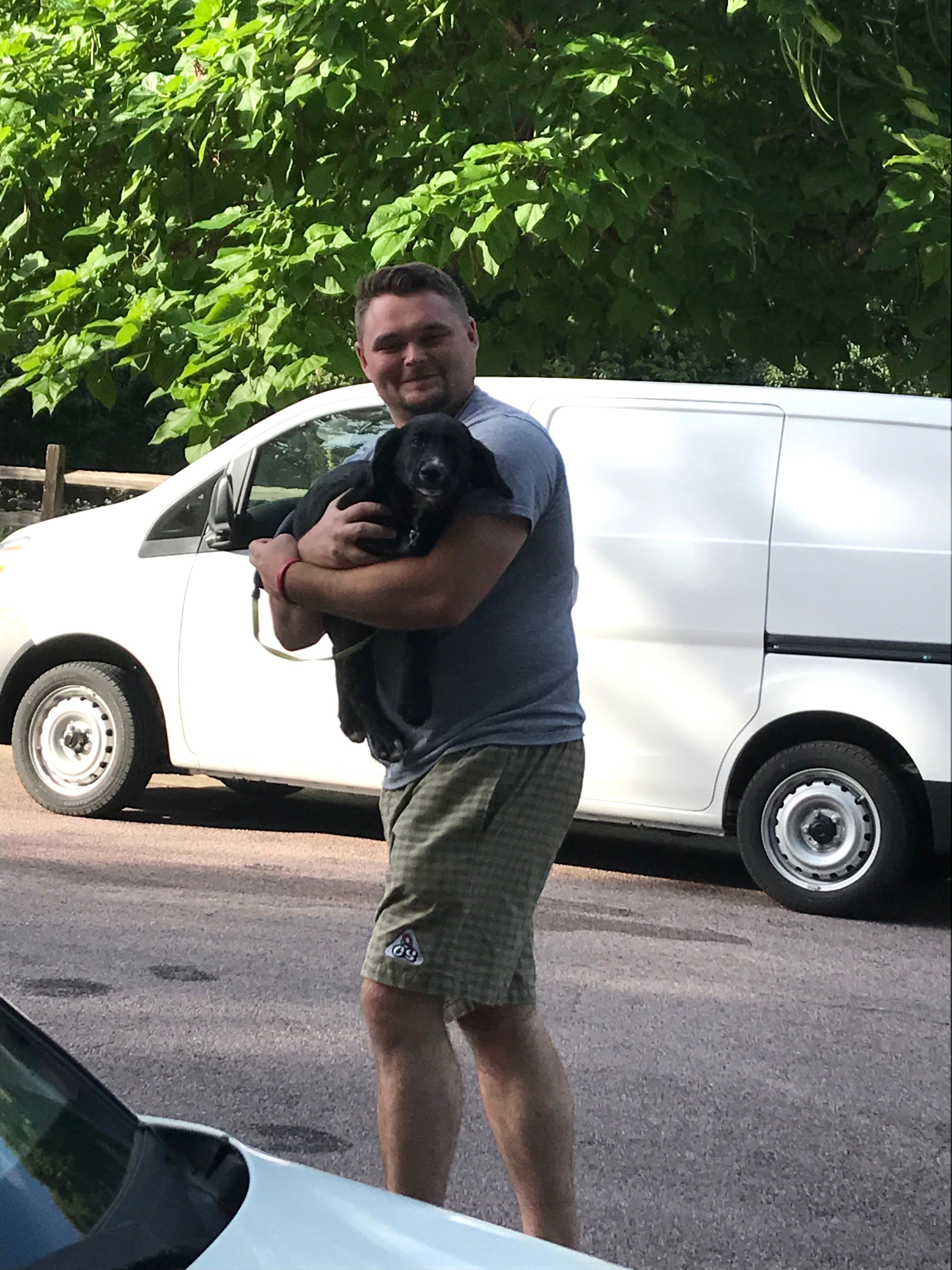
My colleague delivered the young dog to my door.
I couldn’t sleep the first night, listening for every move as he slumbered with one of my sweatshirts and a new blanket in a crate next to my bed. I fed him by hand twice a day for the first six weeks, having read somewhere it was a good way to start a puppy. He didn’t get table scraps and was not allowed on the furniture.
I can see how new parents get wound up.
Seven months later, my colleague collapsed one morning shortly after arriving at work. Typing away in the basement of the house on the edge of campus that served as the marketing and communications office, I heard a commotion, raced up the stairs, and saw a squad car pull up outside. Two coworkers were doing CPR on the floor by the reception desk. When my calls to our boss went unanswered, my adrenaline spiked. As soon as the ambulance arrived, I ran down the campus mall and broke up the weekly cabinet meeting in the president’s office.
Hayley and I snuck away from campus for a few hours on Sunday. We were at a brewery in Minneapolis with some friends when my boss called. I answered, of course, and he told me she was gone. Pacing the loading dock, I started running through mental checklists and next steps. Who needed to know? Who’d be the one to tell them? How could the college help? How about me? What’d come after that? And then after that?
“Take care of yourself,” I said before hanging up.
~~~
Duke’s nine now. He’s been allowed on the couch and bed for almost all of it. Still no table scraps, but that’s mostly because of his sensitive gastrointestinal system. The move to Nova Scotia was not without consequence for the dog, who tore a cranial cruciate ligament (CCL) within minutes of arriving after a 30-hour road trip, then the one in his other knee shortly after. His introduction to life in Bayview was six months of careful rehab. Duke’s settled in now, with his yard and trees and morning visits from our neighbour’s guinea fowl. A few times a week, he visits my mother-in-law’s border collies for a playdate or rides along as I run errands.
Mid-July. Lobster season had provided a good jolt to my burnt-out system. Three weeks later, I still can’t feel the tips of a couple fingers. I’m settling into a quiet summer but haven’t quite found a rhythm. The days stretch before me but already feel like they’re going too fast. I struggle to do nothing, so I settle for doing nothing productive instead.
As part of my efforts to hurry up and relax, I make a point to enjoy the simple pleasure of mowing the lawn each week. I listen to music through my earbuds as I push the electric mower in straight lines across the yard and think about fanciful things unrelated to questions of vocation and capital.
Duke meanders the lawn as I mow. Now he’s behind the garage, now chewing a stick, now nosing the treeline. I’ve always kept a close eye on the dog, and believe me he’s a good one. Duke loves people. He’s good with children and the elderly. A little nervous of loud sounds and new things. Throws up more often than I might like. Listens to me usually and Hayley some of the time. He gets excited easily even though the excitement wears him out. Handsome too, and one of the sweetest dogs you’ll ever meet.
I’m pacing tight rows across the back yard when Duke wanders over and splays out on the grass and clover. I pass him a dozen feet away, then closer from the other direction. This battery-powered rig isn’t as loud as a gas engine. He eyeballs me but doesn’t move. Heading toward him again, I holler and try to wave him off. He stays put. I turn at the treeline and come back the other way. Eventually, he slowly stands up. He gives me a reproachful look, then strolls a few paces and lies down in the uncut grass. I stop the mower.
“Go over there,” I gesture with both hands to the finished half of the lawn. “Look buddy, go over there.”
He doesn’t go anywhere. Fine. I start the mower and march ahead. A few rows later, I slowly approach. He rolls over and looks at me, then stretches and saunters ahead. We repeat the process again, then again. Each time he moves away from the approaching lawnmower, he places himself back in its path.
This is not logical.
Is it strange to think the dog should make rational decisions?
Or maybe it makes sense, just not to me. Maybe that uncut grass is more comfortable, more familiar. Maybe it’s preferable even if it means the same thing happens over and over.
After finishing the lawn, I put the mower away and pat Duke on the head as we walk together back to the house. I’m glad I said yes to the puppy all those years ago. He’s a good dog. He’s a good boy. I try to remind him often.
In the evening, Duke snoozes at our feet as we eat supper in the screen porch. Hayley compliments the yard. I’m pretty happy with it, I guess, but there are a few things I should do better.
The next day, I’m thinking it’s funny how we can learn from our mistakes and somehow still repeat them when my mom and dad pull into the driveway. They’re just arriving for a two-week visit after a road trip from Minnesota.
“Duke looks great,” my mom says. “The yard looks great.”
She leans in for a hug.
“Everything looks great.”
~~~


The Greek philosopher Heraclitus said that a man (and his dog, I presume) can never step in the same river twice.1 You get the idea: between the flow of the water and the passage of time, it’s not the same river and it’s not the same man (or dog). Everything is transient. Perhaps there is no centre.2 Change is all there is.
Hmm.
As is often the case when I’m not quite sure about something, I asked a friend for help.
Lisa Heldke also loves dogs and thinking about weird shit (or, more accurately, thinking about normal shit in ways that other people often consider to be weird). It just so happens that she’s a philosopher with a PhD from Northwestern University, the author of four books, the former director of the Nobel Conference, and a sought-after international lecturer who’s spending the autumn teaching at the Universita di Scienze Gastronomiche di Pollenzo in Italy.
Back in Saint Peter, we used to share meals and meet up at the local alumni-owned brewery to commiserate about life.3 She spends summers at her off-grid yurt in Maine. (Read about it here.) When Hayley and I got married on Pictou Island in 2019, Lisa drove up the coast, found a boat ride across the Northumberland Strait, and pitched a tent at the edge of the woods. I like philosophers in general, but especially the ones who aren’t afraid to get their hands dirty.
“I come away from my reading,” Lisa explained, “seeing Heraclitus as a guy who says: ‘listen, to be is to be changing. Maybe sometimes becoming, but sometimes also falling apart. Being is change.’"
Hayley loves the dog very much. This is made easier by the fact that he is her first Duke. She thinks reusing the name is strange. She says the idea of calling a new pup the same thing makes her sad. She says every time she said it she would miss the old dog. And then there’s the argument that to give the same name to another dog is to somehow dilute or divide the memory of the one(s) that came before.
I get it.
Or, you can decide you believe in some sort of quasi-reincarnation in which the new dog is imbued not with embodiment or memory or even the spirit of the old dog, but rather the cosmic essence of a trusted companion—your trusted companion.4
“Heraclitus thinks that the cosmos5 is everlasting, that its ‘stuff’ lasts forever and is never destroyed,” Lisa said, “and that that ‘stuff’ can change in absolutely astonishingly dramatic ways.”
Perhaps, then, the name is a talisman. Picture an old magic collar taken off the shelf and placed gently over the head of the young pup. I know you’re new here, you say, but we’ve been through it before. You won’t remember, exactly, but you’ll get it. I take care of you and you take care of me.
Being is change. And change can be scary.
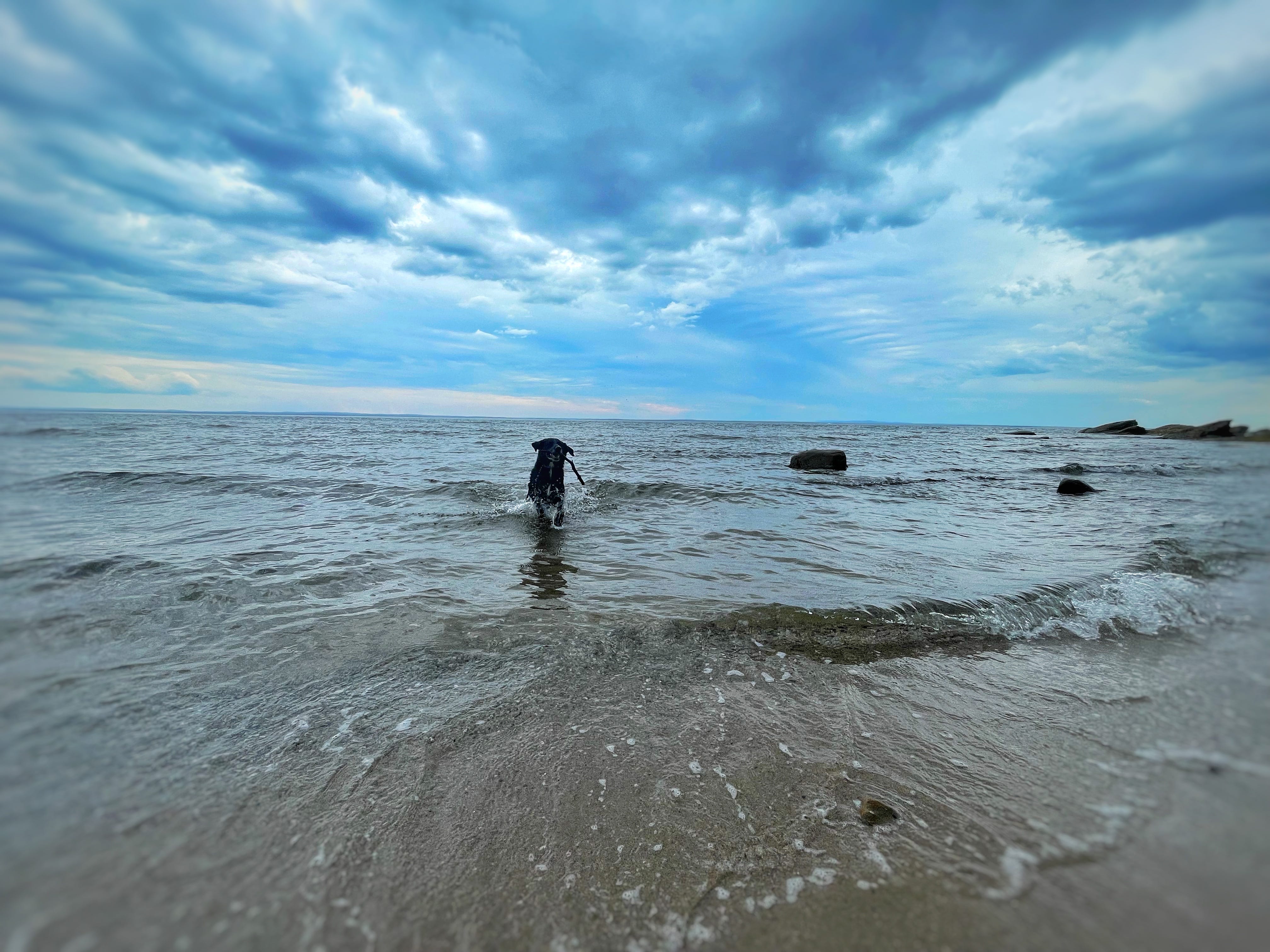
It’s easier when you’re standing knee-deep in the water next to a dog named Duke.
Don’t take my word for it. https://plato.stanford.edu/entries/heraclitus/
W.B. Yeats. https://poets.org/poem/second-coming
Everyone should have a friend who’s an American pragmatic feminist food philosopher approaching life in the spirit of Deweyan Inquiry.
Do I really believe all this? Well no, not in a fact-based way. But isn’t it nice to think so? After all, philosophy seeks to answer questions that science cannot.
“Cosmos” means “universe” and also generally indicates “an orderly harmonious systematic universe”— a place with a centre, even if that centre is continual change. https://www.merriam-webster.com/dictionary/cosmos
aroooooooo.
reading this made me miss you guys and my dog.
thanks for the heraclitus shout out. that guy needs better press than the single one-liner people always trot out.
Bode and Blue are glad too. 😊