


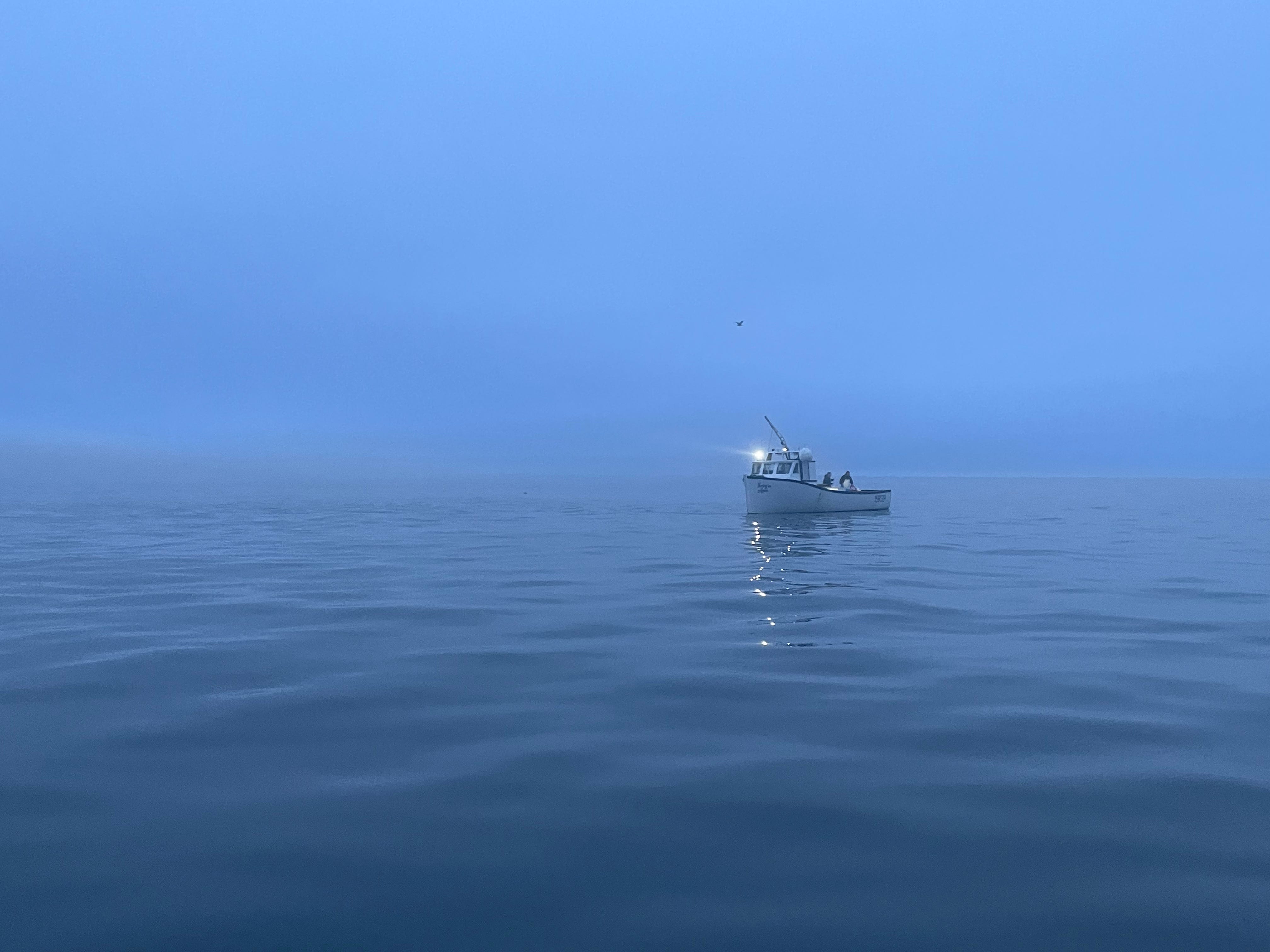
A lonesome spotlight plays across the water, searching wave troughs for hidden buoys in the hour before daybreak. Our eyes are cast downwards, scanning the surface for a Hayley & Noah marker. The lights from other fishing boats blink across the horizon. As the fleet bobs and circles, the flickers seem to create a sort of shorthand Morse code.
Flash-Flash.
I’m here. We’re looking too.
Sweep. Stop.
I might’ve found something.
Flash-Sweep. Flash.
It’s not what I was searching for.
“I hate fishing in the dark.” Eddie Lyons jolts me from the not-quite-daydream. “Can’t see shit.”
Eddie’s in the cabin while Austin and I are out back on the deck. We learned very early in the season that our captain likes to talk to himself. He also likes to talk at the VHF radio (but not into it), the other boats, the buoys, the traps, his deckhands, and the odd lobster.
When I was growing up, my grandmother had a radio in the kitchen that was constantly tuned to WCCO News 830 AM out of the Twin Cities. Depending on what happened it got turned up or down but rarely off, sharing background noise and occasional insights that helped pass the long days on the farm. Like “The Good Neighbo(u)r,” Eddie’s commentary provides a certain level of comfort.
“We should be right on ‘er, boys,” he yells over his shoulder. “Call it out when you see it.”
We’re looking for the Hayley & Noah’s distinctive baby pink buoys with black spindles that had been used for years by my late father-in-law, Nipsy. Eddie keeps track of their locations on the water using redundant systems: digital chartplotters along with pen and paper.
The problem on this Tuesday morning is that we can’t find any of them.
Or anyone else’s buoys, for that matter.
It’s an eerie feeling.
They could be anywhere.
The day before, I was pulling on my rubber boots at 4:03 a.m. when I got a text from Eddie that there was no need to rush to the wharf. Wind had picked up throughout the day on Sunday, blew hard all night, and was showing no signs of letting up on Monday morning. Half an hour later curiosity got the best of me and I drove down to the wharf, dodging a fallen tree on Bayview Road along the way.
Caribou Wharf normally bustles with activity before dawn as helpers load and cut bait and captains warm up the diesel engines and prepare to cast off. The only sounds this Monday were creaking dock lines and rubber fenders muffled by wind and rain. A handful of idling vehicles sat scattered around the wharf as fishers decided whether to go out. I took a slow spin around, checking for the boats that Nipsy and Eddie considered their closest peers. They were all tied up and dark, just like the Hayley & Noah.
“Sucks that it’s a Monday,” I texted Eddie.
With no fishing on Sundays, the traps had been down since Saturday afternoon. The extra day means that Monday’s haul is usually a big one. But only so many lobsters will go in a trap, and a day without fishing is a day without profit. The deckhands have other concerns with the extra day, like how the bait starts to go bad and becomes much more unpleasant to clean out when the gear is finally pulled up.
“Yeah it does,” he replied, “but you can’t change Mother Nature.”
From shore, it was hard to tell how bad the conditions were outside the channel.
The hardest part of the extra day off was choosing to not go back to bed.
The rest of the week would require a bit more resilience.
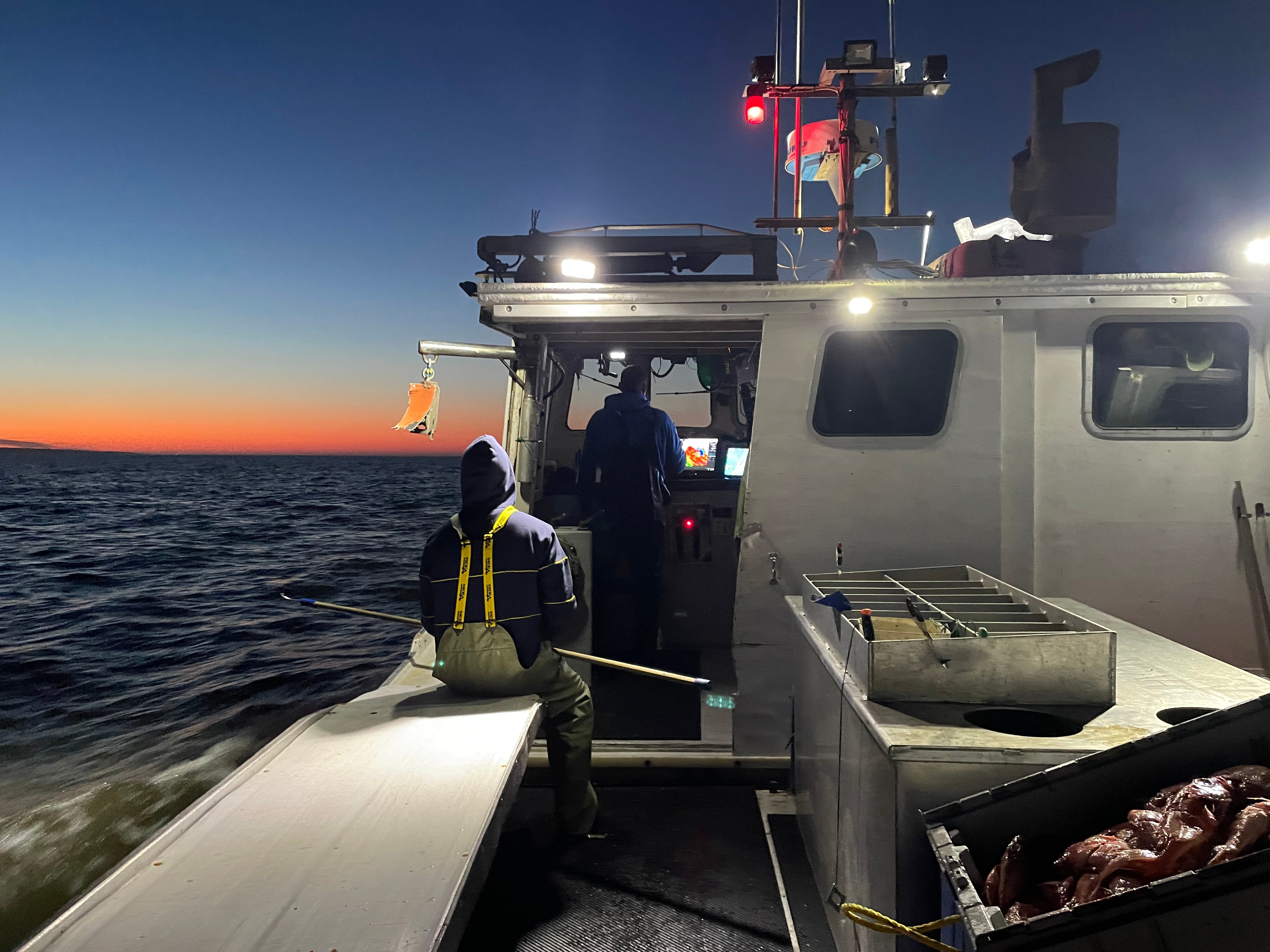
We’ve been on the water for over an hour and have seen just a handful of buoys. The sun comes up over the Northumberland Strait as we sweep the waves in search of our trawls.
The first one we find is tangled with another boat’s gear. The other crew is already working to straighten things out.
“Is it okay if I take off a few of your traps?” the other captain calls across the water to Eddie.
“It’s some mess,” he shouts back. “Do what you gotta do.”
Austin and I trade a glance. It’s going to be a long day.
We motor away to find another set of buoys.
“Damn these wood traps,” Eddie mutters.
The Hayley & Noah’s traps are made of thick wire. Nipsy did without many of the creature comforts that some fishers implemented on their boats, but he never cut corners on traps or bait. Eddie is a true disciple of the philosophy.
“Ours should pretty well stay where we put ‘em, but wood traps are lighter and get dragged around in the wind,” he says.
We pull up to one of our trawls. The buoys, normally dozens of yards apart, are bunched together along with two yellow buoys from another boat.
“[Redacted],” Eddie grumbles.
Austin reaches out with the gaff and carefully snags our buoy. Eddie slowly hauls up the trawl. The first trap comes up along with a knot of rope the size of a basketball.
“[REDACTED!]” Eddie bellows.
The second comes up with another big tangle of rope along with a wooden trap from the other fisherman’s trawl. They dangle along the gunwale as our captain gets to work.
Eddie spends the next half hour picking at the mess as we bob and roll on the water. He cuts and re-ties three of the five snoods that connect our trap line to the main trawl rope.
On the bright side, we’re starting to find our buoys now that the sun is out and we have an idea of how far they’ve moved. The GPS and written coordinates are useless. Some of the buoys have traveled almost a mile in the storm. Eddie’s finding them by dead reckoning and feel borne of years of experience on the water.
One rope is completely trashed so we have to replace the full trawl line on a set of traps. Fortunately, Eddie has a spare stashed away in the cabin berth. Another lesson from Nipsy.
We pull alongside the boat from earlier to reclaim the traps they’d removed.
“Never seen ‘er like this,” the other captain says.
It takes us four hours to clear our first 11 trawls.
We arrive back at the wharf at 5:30 p.m. I’m exhausted after more than 12 hours on the water. I got sick twice after the wind came up in the afternoon. Somehow, we found all 56 of our trawls. Many other boats weren’t so lucky.
“One of the older guys said he hasn’t seen something this bad since ‘86,” Eddie says as we tie up the boat back in Caribou.
This is helpful context. One of the things that’s been difficult to understand as a new fisherman is what “normal” looks like. This storm was not. Good to know.
The fallout lasts all week. On Saturday, fishermen are still calling out the location of other boats’ buoys over the radio. Some gear never resurfaces. Every complication costs time, money, and morale. Word at the wharf is that several helpers have quit.
Commercial fishing is never easy. By Tuesday evening, I’m learning just how hard it can be.
Unfortunately, the lessons will continue over the next few days.
Love reading about these adventures! Thanks for taking the time to share JJ!
Nice description of some of the many challenges of fishing. You are fortunate to gain such experience with such a good captain and good crew mate.