


I looked up. The captain looked down.
“What the hell are you doing there?” he asked.
Nothing witty came to mind. Being quick on your feet doesn’t count for much when you’re crumpled in a heap on the floor.
“Are you alright?” he asked.
Earlier, a can of Diet Coke (okay, my can of Diet Coke) had overturned in the rough conditions despite being wedged into a cardboard drink caddy from Tim Hortons. On cold, windy days, the deckhands try to grab as many short breaks as we can in the relative warmth of the cabin. Hustling inside after finishing a trawl, I misjudged the impact of a big wave, slipped on the remnants of the sugar-free cola, and crashed down on my left hip and shoulder before skidding into the base of the instrument console at the captain’s feet.
I mustered a grin and flashed a thumbs-up from the deck. Lobster fishing is a choice, I frequently remind myself. Lobster fishing is a choice.
But it was shaping up to be one of those days.
I’m sure you understand that I cannot reveal the proprietary information that has been entrusted to me as a deckhand on the Hayley & Noah. Bait type, amount, and presentation. Trawl locations. How many lobsters we’re catching and where. Some of the other complicated dynamics of the fishing business. You get the idea. Fishers must protect their trade secrets, revealing them only when sealed with a blood oath, or occasionally to one-up someone at the wharf. To be a good member of the crew, you must be comfortable with fish guts, diligent when measuring lobster, and wise enough to know when to keep your mouth shut.
But let me address your most pressing question: In such a motion-rich environment, why did I have a can of Diet Coke instead of a bottle? The answer is simple and obvious. Cold aluminum cans of pop have significantly better medicinal qualities than other forms of soda delivery.1
Anyway, avoiding seasickness is a complex equation and I’m still figuring out the variables that work best for me. Right now, that usually looks like an early morning cup of coffee before heading to the wharf, a Gravol (Dramamine) tablet as we sail to the fishing grounds, and one or two cold cans of Diet Coke throughout the morning. Pickles seem to work well—to the tune of multiple jars per week. I supplement with water and add a chewable Gravol Ginger as needed. Fishing wisdom says that eating a meal helps, but my current theory is that it cuts both ways—reducing the symptoms of seasickness to some degree, but increasing the unpleasantness if vomiting does occur. Life is all about tradeoffs.
So far, I’ve gotten sick out there half a dozen days or so. And we’re not going in early just because one of the deckhands is ill. When the wind is up and the waves are rolling, the nausea builds throughout the day. The first several hours aren’t too bad, but by late morning on rough days I find myself looking up from the sorting table to find the nearest point of land and take a few deep breaths. If the wind is blowing the diesel exhaust in my direction, it’s worse. If I stand out back and take in some fresh air between trawls, it improves to some degree. But the effect is cumulative, and there comes a point on those windy days where I end up putting down my banding tool and making a deposit on the deck at the back of the boat.
Why puke on the deck? It’s not a great idea to lean out over the rail when the boat is rocking. Safety first. Plus, the scuppers at the stern are frequently awash with seawater to carry away my shame.
On the bright side, the sudden cleanse of my upper gastrointestinal system makes me feel better for the next several trawls. Vomiting, in this case, improves my efficiency as a deckhand.
For awhile anyway.
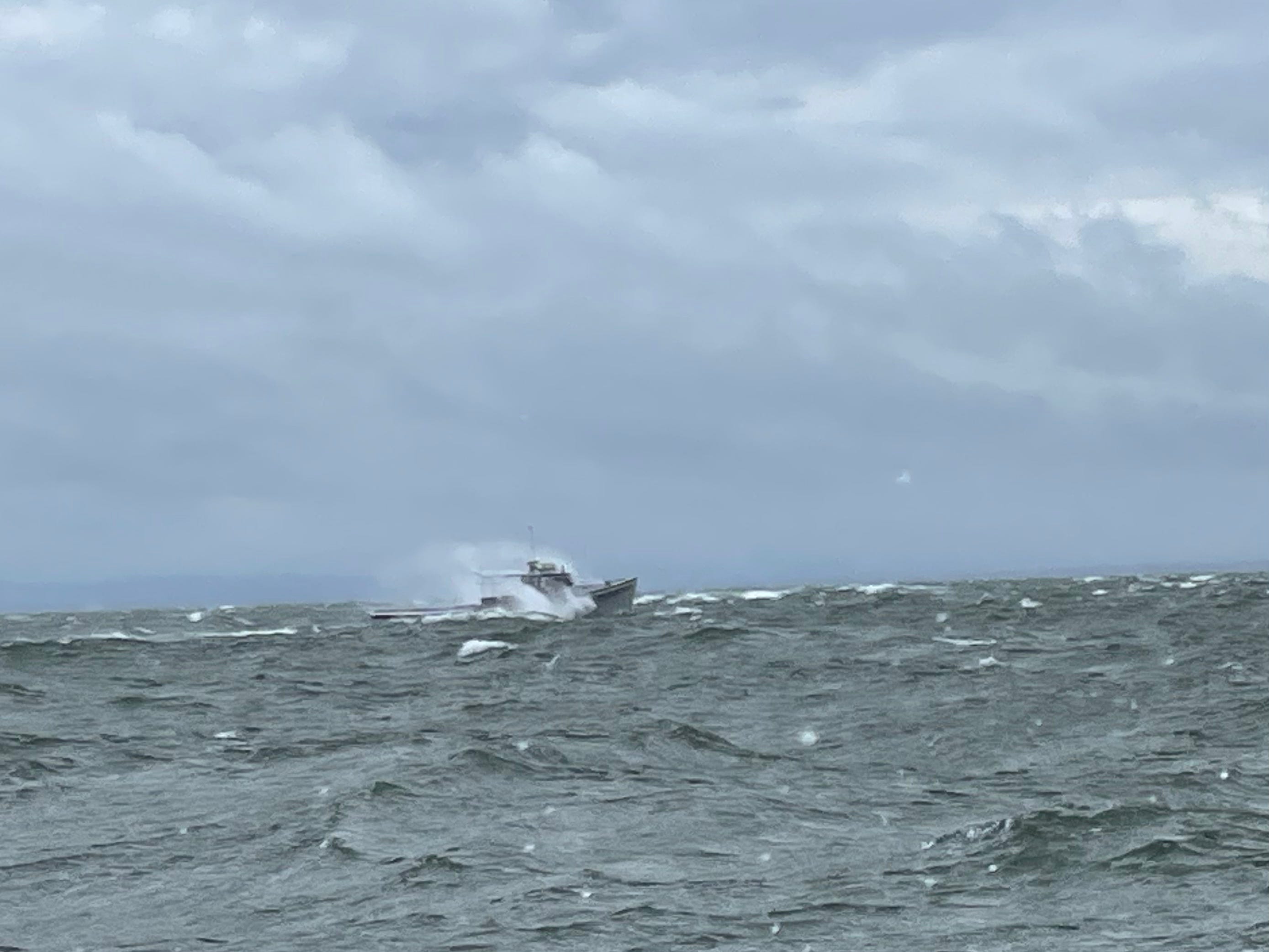
The captain takes the engine out of gear as we hook a buoy with the gaff and begin hauling the trawl aboard. The boat swings around and ends up parallel to the waves. On windy days, this results in the deckhands picking lobster from the traps and replacing bait as the boat rocks precipitously between the crests. One second you’re looking at nothing but sea, the next you’re staring at the grey sky. A couple weeks ago, I lost a ballcap after a gust blew back my hood, caught the brim of my hat, and carried it over the rail where it disappeared into the foam of a departing wave. When the wind is really howling, the doors on the traps blow shut on our arms as we reach in to grab lobster.
It’s invigorating, I guess, but not something I’d describe as fun.
Sailing back to the wharf on the day that I slipped on the Diet Coke, we got caught in some especially rough seas when the tide turned against the direction of the wind. This “wind against sea” or “wind over tide” condition results in steep waves that stack up more closely together than usual and are more likely to break than roll. In these chaotic and unpredictable seas, a particularly big wave tossed the boat and left one of our monitors dangling by its cord in the cabin’s berth. The lobster tank on the back of the boat slid three feet to the right. Filled with hundreds of litres of water, it caused the boat to list to starboard. After a white-knuckle sail, we cleared the Caribou Island light and entered the relative protection of the channel that leads back to the wharf.
All of this is to say that it’s been an unusually stormy spring on the water. Characters at the wharf have described it as “dirty,” “rank,” and plain old “shitty.”
This being my first full season on the boat, I’d suspected this might be the case. I’m glad to hear the notion confirmed by the more experienced fishers, not that the validation makes things any easier out there. We’ve missed a few days due to the weather and cut several others short after getting tossed around (and in my case, sick) on the water. These disruptions cause much consternation at the wharf. In a two-month season, every day counts.
Despite the conditions, I like it. I’m learning that dealing with unexpected circumstances is part of life in the fishing industry.
On a related note, the Hayley & Noah is now captained by Regan MacCarthy, a 30-year old electrician who grew up on the water and spent the last decade fishing with his father. I’m joined on the back of the boat by Emelyne and Matt Langille, who are splitting days while juggling work commitments and childcare.
That’s all for now. Proprietary information and all that.
The obvious exception being fountain drinks from McDonald’s, though those are most effectively utilized as a hangover remedy.
I’m feeling woozy just reading this post. So nice to hear from you, JJ!
Always enjoy your posts, JJ!